‘Protein’ Present In Snake Venom Could Advance Drug Development
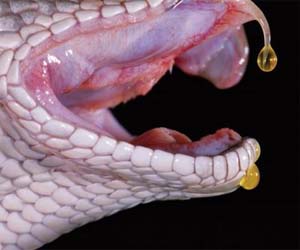 According to scientists, protein present in snake's venom has the potentiality for new drug invention and to boost understanding of disease methods.
The protein known as haditoxin was detected in Prof. Manjunatha Kini's research lab at the National University of Singapore.
Report's co-author Dr. S. Niru Nirthanan has characterized the pharmacological actions of haditoxin.
Dr. Nirthanan also said that haditoxin was unique with respect to structure unique and therefore expected to have unique pharmacological properties.
"This toxin is like a conjoined twin. It is a relatively large complex made up of two identical protein molecules known as three-finger toxins linked together. We know that the family of three-finger toxins display diverse biological actions on the human nervous system, cardiovascular system and blood clotting. Some have directly led to the development of compounds with potent analgesic and blood pressure reducing properties - so it is likely that haditoxin in its ''conjoined twin'' state or as individual components will offer us more novel insights," Dr. Nirthanan added.
Nirthanan stated that various common medicines including the widely prescribed BP drug Captopril and anti-clotting medicine Eptifibatide have been created from snake and other animal venoms.
"Researchers have been studying King Cobra venom for over 50 years and yet we are still identifying new compounds. It is a complex cocktail of biological molecules that can change composition depending on the environment, the season or even the snake''s diet," he added.
Primarily, the venom acts on neurotransmitter receptors that control communication between neurons or between nerves as well as muscles, causing symptoms like paralysis and respiratory failure.
While not every new toxin will alter straightly into a clinically useful medicine, he said there was potentiality for haditoxin to be a main compound or template from which to make other medications.
The sensory receptors are vital in neurodegenerative conditions like Alzheimer''s and Parkinson''s diseases as well as in schizophrenia, nervousness and depressions and drug addiction.
The results of the study have been reported in the high-status Journal of Biological Chemistry. (With Input from Agencies)
TopNews Hindi
- आज का मौसम 29 मई: 16 राज्यों में तूफानी बारिश का अलर्ट, दिल्ली में राहत की उम्मीद लेकिन मानसून अभी दूर
- सोने और चांदी की कीमतों में मामूली गिरावट (Gold Price Declines Today), 22Karat सोना 1,56,600 रुपये प्रति 10 ग्राम
- वैभव सूर्यवंशी (Vaibhav Sooryavanshi) की IPL 2026 में राजस्थान रॉयल्स में रिकॉर्ड तोड़ बल्लेबाज़ी
- कल का मौसम: दिल्ली, हरियाणा, राजस्थान, पंजाब और उत्तर प्रदेश में अत्यधिक गर्म मौसम
- आज का मौसम: दिल्ली में भीषण गर्मी का प्रकोप, 45°C के पार पहुंचा पारा

