Hong Kong - Hong Kong officials Monday welcomed the bailout deal for the US economy but questioned whether the 700 billion US dollars in the package will be enough to revive global money markets.
Hong Kong's financial secretary John Tsang said he hoped the rescue package could be implemented quickly so that it would stabilize not only the US economy but the global financial system.
Hong Kong Monetary Authority chief executive Joseph Yam said the plan would reduce the danger of further failures of financial institutions in the US.
Sydney - The 700-billion-US-dollar bailout package being thrashed out in the US Congress is more likely to reinforce rather than curb the risky financial dealings of investment bankers, Australia's stock exchange head said Sunday.
Maurice Newman, the chairman of the Australian Securities Exchange (ASX), warned that the government paying top-dollar for worthless assets would worsen the predicament of Wall Street.
"The moral hazards which are being created in the United States right now - the idea that more oversight, more regulation, the automatic default whenever there's a problem will get you out of trouble - will only make the problem worse," Newman told local television.
Washington - US legislators worked behind closed doors through Saturday seeking agreement on a US finance rescue plan as a weakened US President George W Bush wrestled with a revolt from within his own Republican ranks on a tense Capitol Hill.
House of Representative Republicans continued to block approval of the mammoth 700-billion-dollar liferaft for the mortgage-debt-gone- bad crisis that has drained credit lines dry and is spreading financial troubles abroad.
The Bombay Stock Exchange, the country's oldest exchange will launch exchange-traded rupee futures on October 1.
Last month, the National Stock Exchange of India kicked off exchange-traded currency futures trading for the first time in India.
The leading commodity bourse MCX Stock Exchange Ltd has also received an in-principle approval from the SEBI for the launch of exchange-traded currency futures.
The 30-share index, BSE Sensex lost 940 points during the week ended Sep 26, on depressing reactions including delay in US bailout plan, closing of America’s second biggest banking institution caused a global meltdown.
Moreover, the continuing credit crisis was another reason that pulled the Sensex down.
Inflation remained unaltered at 12.14% for the week ended September 13 even as the Finance Ministry said prices of essential items like cereals, pulses, sugar and edible oils went down on a weekly basis
 Hong Kong - Hong Kong officials Monday welcomed the bailout deal for the US economy but questioned whether the 700 billion US dollars in the package will be enough to revive global money markets.
 US legislators worked behind closed doors through Saturday seeking agreement on a US finance rescue plan as a weakened US President George W Bush wrestled with a revolt from within his own Republican ranks on a tense Capitol Hill.
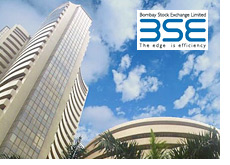 The Bombay Stock Exchange, the country's oldest exchange will launch exchange-traded rupee futures on October 1.
  on depressing reactions including delay in US bailout plan, closing of America’s second biggest banking institution caused a global meltdown.
