Czech president rouses dormant nationalist ghosts
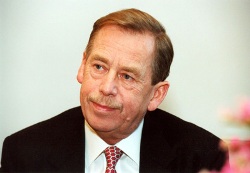 Vratislavice nad Nisou, Czech Republic - Twenty years after his predecessor Vaclav Havel opened his country to the world and set it on a path to the European Union, Czech President Vaclav Klaus is closing the door and awakening nationalist ghosts.
The president's latest condition for his much-awaited signature on the EU's key reform treaty is but the most recent instalment in a brand of nationalist politics that brings him significant public support.
The intent of the Lisbon Treaty is to further unite the 27-member bloc in a bid to turn Europe into a powerful global player. Klaus has consistently opposed greater European integration. But after Ireland said yes to the treaty in a second referendum earlier this month, he likened the accord to an unstoppable train.
Klaus quickly reverted to old form, hatching a face-saving ploy that would allow him to sign the treaty without compromising his eurosceptic reputation.
In exchange for his signature, Klaus demanded an exemption from the pact's Charter of Fundamental Rights. He claims it opens the way for property claims by ethnic Germans expelled from former Czechoslovakia after World War II.
This precondition has sparked an uproar among his critics. Havel, a long-time rival, has called the demand "dangerous" and "irresponsible."
But to his critics' shock, a opinion poll published in mid-October by the daily Lidove Noviny found that 68.5 per cent of Czechs back the Klaus opt-out.
Iva Hrubesova, a 37-year-old mother of three, is one supporter of Klaus' position.
"Even if (the former owners) would not win it back, the uncertainty would be nerve-wracking," said Hrubesova, who lives in Vratislavice nad Nisou, formerly Mattersdorf, a northern Czech town previously inhabited by many ethnic Germans.
Her family rents a flat in what was once a grand villa in a once thriving German community.
Germans settled in Vratislavice in the 16th century and founded prosperous enterprises. The house where Hrubesova lives belonged to the family of Konrad Henlein, a Sudeten German separatist politician who sided with the Nazis prior to World War II.
After the war, Czechoslovak President Edvard Benes issued decrees under which the 3-million Sudeten German minority was forced out and their properties seized as a punishment for backing the Nazis.
Hrubesova's grandmother was a local German who escaped expulsion because her husband was Russian. Yet Hrubesova's 17-year-old daughter, Anna, does not want Germans to come back.
"They should not be here. It would be as if we were living in their country," she said.
Anna's schoolmate, 18-year-old Lukas Zabka, was equally perplexed by the vision of an ethnically mixed society.
"It would be weird," he said on a recent chilly afternoon. "One house Czech, another German. We would have to learn two languages at school."
Nearly 65 years after the war, surveys still show that some two- thirds of Czechs see Germany as a potential threat, despite their shared membership in the EU and the North Atlantic Treaty Organization, sociologist Vaclav Houzvicka said.
"The reality is that once you push the button of the Sudeten German question, people will react this way," said Houzvicka, who lectures at JE Purkyne University in the northern Czech city of Usti nad Labem.
Since the Cold War ended nearly 20 years ago, Czechs have failed to come to terms with this questionable chapter in their post-war history, said sociologist Jaroslava Gajdosova, who teaches at the Anglo-American University in Prague.
Not much has changed in the public debate, sociologists said, since Havel outraged his compatriots in 1989 by apologizing for the expulsion and calling it "the evil which was a revenge for the previous evil."
"Czechs view themselves as victims of the Nazi occupation," Gajdosova said. "They want to maintain the role of the victims and thus cannot accept the role of the perpetrators."
A minority position is that of 60-year-old radio journalist Jana Smidova, who splits her time between Prague and the former Sudeten German village of Blatce, formerly Grossblatzen, 70 kilometres north of the capital.
She lost many in her family to Nazi concentration camps. But Smidova does not see the expulsion as just, and she rejects politics based on invoking historical traumas.
"The European Union was born to do away with age-long hostility between France and Germany, and these countries no longer bleed in grisly wars. And now these ghastly demons of the past are being pulled out," she said.
Klaus skillfully employs these demons together with a politics of forgetting, commentators have observed. Unlike Havel, he does not make Czechs feel guilty for the failings that helped them zigzag through the 20th century's totalitarian regimes.
It may be no coincidence that two decades since the fall of Europe's communist regimes in 1989, the Czech president is choosing to celebrate the Czech Everyman instead of paying tribute to the heroism of the regime's unwavering opponents.
Wednesday night, three weeks before the 20th anniversary of the Velvet Revolution that brought democracy to Czechs, Klaus awarded the Medal of Merit, a prestigious state honour, to pop star Karel Gott, whose life is a symbol of the painful personal compromises of the Communist era.
Before he was immortalized in Milan Kundera's The Book of Laughter and Forgetting, Gott enjoyed popularity mainly in Central Europe and the former East bloc.
The Czech-born Kundera, whose fame spread after publication of that novel, brought Gott to the attention of a wider audience. He cast the crooner as an "idiot of music" who sustained his career thanks to a symbiotic relationship with the Communist regime and Gustav Husak, its last "president of forgetting." (dpa)

