Featured

Simulated seismic signals could help save lives during volcanic eruption

Washington, Oct 26 : Scientists have simulated the seismic signals that precede a volcanic eruption for the first time and created a 3-D visualization of those warning signs under controlled conditions, which could help save lives in case of an actual catastrophe.

According to a report in Newswise, the simulation has been made by an international team working out of the University of Toronto’s (U of T’s) Rock Fracture Dynamics Facility in Canada.

By performing tests on basalt rock from Sicily’s still-active volcano Mt. Etna, the team was able to record the seismic waves generated during the earthquakes that occur before volcanic eruptions.

Computer game graphics reveal vortex physics

London, Oct 26 : State-of-the-art computer graphic systems developed for movies and games have made it possible to model in unprecedented detail the swirling rings and tubes that are a characteristic of turbulent vortices.

According to a report in New Scientist, the models will help explain the forces that govern vortex decay.

This could lead to ways to control them in places where they cause problems, such as over aircraft wings or in blood vessels.

Computer graphics technology for games and movies has progressed to the point that it can render photoreal simulations of flowing liquids.

Creams can make skin drier

Washington, Oct 26 : A new research has confirmed for the first time that normal skin can become drier from creams.

The findings are based on Izabela Buraczewska’s study, in which she looked at what happens to the skin at the molecular level and also what positive and negative effects creams have on the skin.

Her research has revealed that differences in the pH of creams do not seem to play any role.

She also studied different oils in a seven-week treatment period, but no difference was established between mineral oil and a vegetable oil. Both oils resulted in the skin being less able to cope with external stresses.

Scientists discover new coral reef in the Seychelles

Coral ReefWashington, Oct 26 : Scientists at the Department of Biological Sciences have found a previously unknown coral reef in the Seychelles.
As part of an ongoing study, Dave Smith and Dave Suggett visited Curieuse Island, which is managed by the Seychelles Centre of Marine Research and Technology-Marine Protected Areas (SCMRT-MPA).

Smith and Suggett were joined by PhD student Seb Hennige as well as local Seychelles collaborators.

The island is home to over 200 giant tortoises but it was thought no coral reefs were present.

Migrants stranded in East Timor cheated out of hope

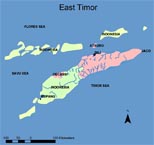
Migrants stranded in East Timor cheated out of hopeDili - Last Saturday, 16 Tamil men waited eagerly on the south coast of East Timor for a boat to take them to Australia.

They were near the end of their journey and they'd spent the last of their money, but it didn't matter. They knew a better life was only 650 kilometers across the sea.

However, the boat never arrived and instead they were arrested and thrown in jail for three days. Now, they are broke, jobless, without legal representation and some are about to be homeless.

Toad’s tongue may inspire improved motors in future

Washington, Oct 26 : A Northern Arizona University researcher is studying a cane toad from Suriname in order to understand the speed, power and energy behind it’s ability to capture prey with its tongue.

Her studies may shed new light on how muscles function more as springs than motors.

This new perspective may help in the development of more efficient electric motors, better prostheses and new medical treatments for neuromuscular diseases like Parkinson''s.

The jaw muscles of toad can produce forces greater than 700 times the animal''s weight.

"The best electric motor achieves about one-third of that force-to-weight ratio," Live Science quoted Nishikawa, as saying.

Pages