Hong Kong leader's address gives little time to political reform
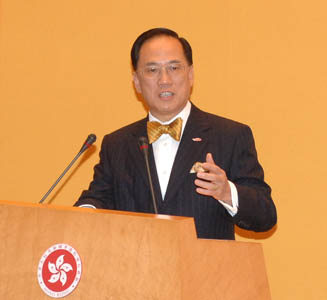 Hong Kong - Hong Kong leader Donald Tsang delivered his annual policy address Wednesday but gave only short attention to the contentious issue of universal suffrage in the former British colony.
Tang promised to listen closely to the views of the different sectors of the community when a public consultation exercise begins next month.
The issue was at the forefront of the minds of several legislators who took advantage of the leader's annual policy address to throw the spotlight back on universal suffrage.
Three legislators with the League of Social Democrats had to be forcibly ejected from the chamber when they shouted demands for suffrage by 2012, interrupting the speech for five minutes.
Members of the Pan-Democracy Party also held banners spelling out a message to Tsang to keep his election promises on suffrage.
Hong Kong reverted to Chinese rule in 1997 under a "one country, two systems" arrangement and a mini-constitution that technically allows for full democracy from 2007.
China has since ruled that there can be no universal suffrage until at least 2017. Currently, there is no popular vote for chief executive in Hong Kong and only half of legislators are directly elected.
In his address, Tsang said Beijing had set a clear timetable on political reform and established a clear direction for the future constitutional development of Hong Kong.
"The decision is the constitutional requirement which we must comply with in handling the issue of Hong Kong's future constitutional development. I believe that different sectors of the community would concur with this," he said.
Instead, Tsang's address touched on subjects ranging from the environment, continued integration with the Pearl River Delta region of China and conservation.
The economy remained the main topic, with Tsang highlighting measures to help support Hong Kong's pillar industries, such as financial services and tourism, and to develop six other industrial sectors which include education, medical services and culture.
Tsang said Hong Kong would adhere to a "big market, small government" policy to help promote those industries and remove barriers to help them tap into new markets.
Analysts said the speech revealed little that was surprising with the exception of a plan to preserve and revitalise Central District of Hong Kong.
This plan includes handing over the old Central Market to the Urban Renewal Authority for revitalisation and turning part of the current government building into a hotel after new headquarters are completed.
"In the face of global competition, many governments are keen on developing new financial districts, building skyscrapers and creating business centres," Tsang said.
"While enhancing the hardware, we should not forget the software. Central is a distinctive business district endowed with rich cultural and historical heritage, which we will do our best to preserve." (dpa)
TopNews Hindi
- FSSAI की शराब कार्रवाई: मैकडॉवेल्स नंबर 1, Old Monk, Antiquity Blue, Royal Challenge पर बैन
- Karuppu, Parasakthi, Thaai Kizhavi, Blast and Kara Among Best Tamil Movies for 2026
- Anupama, YRKKH, Vasudha, Tum Se Tum Tak: सबसे ज़्यादा देखे जाने वाले धारावाहिक
- 2026 FIFA World Cup Current Rankings and Betting Odds for Sports Betting Fans
- JEE Main 2026: Exam Dates, Eligibility, Syllabus जेईई मेन 2026 परीक्षा की तारीखें, योग्यता, सिलेबस

