Merkel to push climate change in "Wall" commemoration speech
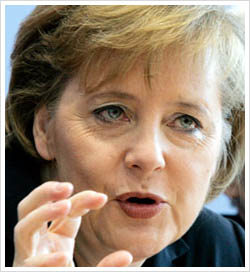 Washington - The 20th anniversary of the fall of the Berlin Wall is giving German Chancellor Angela Merkel a chance to talk to US legislators about an issue close to Europe's heart: climate change.
Merkel on Tuesday will have the historic opportunity granted to few foreign leaders to address a joint session of the US Congress.
While the invitation was intended to mark the end of the Cold War when the Berlin Wall was brought down on November 9, 1989, Merkel has indicated she will also deliver a strong plea for Congress to make sure the US gets on board the carbon reduction train.
"We just can't do it all by ourselves," Merkel told reporters after an EU summit meeting Friday in Brussels.
Merkel, who is to arrive in Washington on Monday, said she would tell Congress it's time for the US to take on a more active role in reducing the greenhouse gasses blamed for climate change. The EU wants wealthy economies to commit to reach emission reduction goals by 2020 under the UN treaty to be hammered out in Copenhagen in December. The new accord would replace the Kyoto Climate Accord that expires in 2012.
The upper house of the US Congress, the Senate, is threatening to undermine President Barack Obama's push for a deal in Copenhagen because it may not pass a climate bill before the talks begin December 7.
The House of Representatives passed a bill earlier this year.
Only about 100 world leaders have ever addressed a joint session of Congress. The only previous German leader to have done so was Konrad Adenauer in 1957, during the deep chill of the Cold War when divided Germany was the geographic and political frontier between the West and the communist Eastern Bloc.
Today, as a united power and industrial engine, united Germany has become a key leader in the fight against climate change, in addition to providing a vital link to the US in transatlantic relations.
Merkel, 65, who grew up in East Germany, is chancellor thanks to the 1990 German reunification, which opened up her climb to become the country's first woman leader.
As a member of Germany's conservative Christian Democratic Union party, she could provide the sort of appeal for climate change legislation that fellow conservatives in the US have balked at, some say.
Merkel's speech to Congress is part of overall celebrations in the US marking the fall of the Wall.
In Los Angeles, 10 graffiti-covered pieces of the Wall will form the core of a huge art project on November 8. In Washington, Germany's foreign minister in 1989, Hans Dietrich Genscher, will join the top White House security advisor of that era, Brent Scowcroft, at a roundtable discussion.
Then there's the plan by Washington's Spy Museum - a memorial to East-West skulduggery - to put 20 Trabants on display, a salute to the little two-stroke-engine cars that powered East German drivers.
It's doubtful however that the exhaust-spewing Trabants would fit into Merkel's emission reduction programme.
The EU is on course to cut greenhouse gasses by one fifth by 2020 compared to 1990. The US draft legislation would only make a 5 per cent reduction. (dpa)

