Study: Stroke Survivors Do Better with Treadmill Workouts
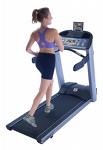 Researchers have found that working out on a treadmill could improve stroke survivors walking ability and may be more beneficial than stretching, which is the traditional prescribed exercise. People who have survived a stroke and gone through the routine rehabilitation programs do better by walking on a treadmill as the walking ability gets improved by rewiring parts of the brain, say experts.
Study researcher Dr. Andreas Luft, a professor of clinical neurology and neurorehabilitation at the University of Zurich in Switzerland, said, "You address two problems these patients have, one is that they don't know how to walk. Not walking, they become deconditioned and lose cardiovascular fitness. With the treadmill type of training, you improve walking and also increase fitness."
Researchers at the University of Maryland and Baltimore Veterans Affairs Medical Center compared the brain and physical function of 37 patients who performed treadmill therapy with 34 patients who did the traditionally recommended stretching. After six months the results were compared on three fronts : brain activities on MRI’s, walking ability and overall fitness levels. The treadmill group had an increased peak walking velocity by 51 % as compared to 11 % of the stretching group. The cardiovascular fitness increased by 18 % in the treadmill group while in the stretching group it decreased by 3 % . A magnetic resonance imaging or MRI showed an increase of blood flow carrying more oxygen to the brainstem and cerebellum in the treadmill group. Treadmill participants also increased their brain activity to certain parts by 72 % on imaging tests while no brain activity changes were seen in patients of the stretching group.
Dr. Daniel Hanley, professor of neurology at Johns Hopkins said, "The most important clinical aspect of the study is that it is saying recovery can occur long after a stroke and can occur even after all the routine therapies have been tried. Scientifically, the most important point appears to be that rewiring of the brain may be involved in this process, not just body conditioning."
In the study published in Stroke: Journal of the American Heart Association, Luft recommends that treadmill work "should be part of standard treatment for every stroke survivor who has a walking habit." "We saw what we call an equivalent of neuroplasticity -- a change in brain activation that reflects the brain's adaptability," says Luft.
Luft though goes on to say that these recommendations could be difficult to follow. "Most physical therapy departments have treadmills, but they don't use them to the extent that we used them in the study," he said. "Because this is exhausting, it should always be done under supervision," he said. "There is always the risk of running into heart problems and falling. We used special treadmills with handrails and also monitored the heart rate to achieve the level of exertion we needed."
Nevertheless, Hanley said, "the study defies current practice." "It is promising that treadmill exercise can stimulate new or underused brain circuits and improve walking in stroke survivors even after completion of conventional rehabilitation therapy," Luft says.

