Spain's "super-judge" under attack over Franco probe
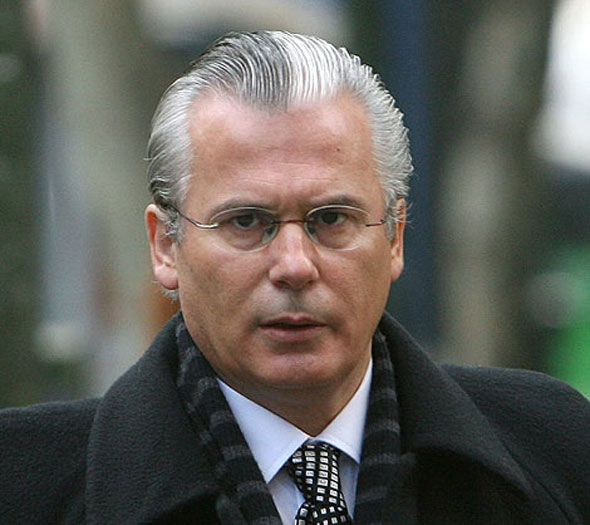 Madrid - For years, Spain's "super-judge" Baltasar Garzon had made headlines for his relentless pursuit of dictatorial regimes, violent Basque separatists, drug lords and other high-profile suspects.
Now, however, the 53-year-old magistrate at the powerful National Court is facing legal proceedings against himself, after the Supreme Court agreed to investigate a complaint accusing him of professional misconduct.
The complaint, lodged by a far-right group, argues that Garzon investigated the human rights violations of Spain's 1939-75 dictator Francisco Franco without having jurisdiction over the case.
If the Supreme Court's decision is confirmed, and is not overturned on appeal, Garzon could eventually lose his job - a thought that has his adversaries rubbing their hands.
The case highlights the fine line separating Spanish courts from politics, with the governing socialists accusing conservative groups or parties of using the judiciary to pressure a judge who has acted against their interests.
Few Spaniards are admired, envied or hated as much as Garzon, who became the hero of the world's human rights campaigners when trying to gain the extradition of former Chilean dictator Augusto Pinochet from London in 1998.
The attempt did not succeed, but it sparked a string of inquiries by National Court judges into alleged human rights violations around the globe.
The court is now handling more than a dozen such cases, ranging from Tibet and Israel to torture at the US prison camp in Guantanamo.
Garzon had been accused of seeking notoriety by choosing high- profile cases, but criticism of him became louder when he ventured to tackle Spain's own human rights record by launching an investigation into Franco's crimes in 2008.
Garzon accused the late dictator and 44 of his collaborators of the deaths or disappearances of more than 100,000 people during Spain's 1936-39 civil war and the ensuing dictatorship.
Prime Minister Jose Luis Rodriguez Zapatero's government had already broken the silence surrounding the Franco era by passing a law aimed at compensating his victims, but Garzon went further by seeking a thorough clarification of their fate.
He was forced to drop the inquiry under pressure from prosecutors, whom some saw as being close to the main opposition conservative People's Party (PP), which has remote links with Francoism.
Garzon's critics argued that the probe ignored the amnesty that was granted to Franco's collaborators in 1977, and that it was ridiculous for him to charge people who were long dead.
Now the conservative Supreme Court judges backed such arguments, "turning their backs to the victims of Francoism," the left-leaning daily Publico headlined.
Conservative politicians and media, on the other hand, welcomed what they regarded as a "courageous" move from the court to rein in a "show-business" judge known for his leftist political views.
The investigation questioning Garzon's professional competence came at a good time for the PP, the chances of which in the upcoming European elections threatened to suffer because of an inquiry into an alleged corruption network involving some of its regional leaders.
The probe was launched by Garzon, who then transferred it mostly to regional courts.
Socialist representative Juan Fernando Lopez Aguilar accused conservative parties or groups of using the judiciary to "frighten" those looking into corruption, though conservative media denied such claims.
Spain's political left is also seen as having battled the conservatives for the control of the country's top courts over the years.
Meanwhile, Garzon's international human rights crusade has also come under pressure from a parliament fearing diplomatic conflicts with some of the countries whose officials are being investigated by the National Court, such as China or Israel.
The judge has, however, survived numerous pressure situations during his career, and many analysts expected the court case against him to be shelved eventually.
Yet, while judges wasted time squabbling over the possibility of investigating Franco's crimes, the ageing family members of the dictator's victims were gradually passing away without seeing justice done, victims' representative Emilio Silva complained.(dpa)

