Doctors hopeful for conjoined twins separated in Australia
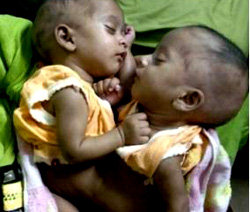 Sydney - Australian doctors are hopeful that joined-at-the- head Bangladeshi twins Krishna and Trishna did not suffer catastrophic brain damage when they were separated in a 31-hour operation earlier this week.
Leo Donnan, head of surgery at Melbourne's Royal Children's Hospital, said the chances of the orphan sisters coming out of the marathon procedure unscathed were still 25 per cent, but that there was no obvious sign of brain damage after the 2-year-olds spent their first night in separate beds.
"We've still got many unknown things that will need to be addressed related to how well they recover from the surgery and how their bodies adapt to the separation," he said.
"They both will have issues with their kidneys and with other organs as well. There is a whole lot of changes that will occur over the next couple of weeks, even into months, and we really don't know how well they will tolerate those."
Their greatest risk is developing infections from the massively invasive surgery, which included skull reconstruction using bone transplants and plastic parts.
Attempts in Britain and Bangladesh at successfully separating twins have failed this year, but an operation in Saudi Arabia on Egyptian brothers was successful.
Six years ago in Singapore, 29-year-old Iranian twins Laleh and Ladan Bijani, who were also joined at the head, died after 52 hours of surgery.
Krishna and Trishna, who were left in an orphanage at birth, have spent the last two years in Australia and are likely to remain in the country for many years because of their needs for specialist medical care. (dpa)
TopNews Hindi
- यिंग्यू यूनिवर्स का गुओफू क्वांटम में 300 मिलियन हांगकांग डॉलर का रणनीतिक निवेश
- Solana ट्रेजरी कंपनी SOL Strategies की Nasdaq लिस्टिंग
- Gamdom ईस्पोर्ट्स, Spartans और Stake.com क्रिप्टोकरेंसी बेटिंग में ग्लोबल लीडर
- MEXC क्रिप्टोकरेंसी एक्सचेंज और Da Vinci की रणनीतिक साझेदारी
- रिपल (XRP Cryptocurrency)और थ्यूनेस की रणनीतिक साझेदारी का नया चरण

