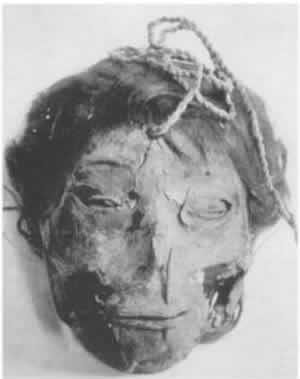
Washington, Jan 15 : A new research has determined that the Nazca civilization, in ancient South America, had a large collection of human heads, which came from their own people.
According to a report in Discovery News, the findings of the research are based on a recent analysis of specimens unearthed at various Andean archaeological sites.
The Nazca civilization, which flourished in Peru between the first century B. C. and the fifth century A. D., is mostly known for carving in the desert hundreds of geometric lines and images of animals and birds that are best viewed from the air.
Stockholm - Two Japanese researchers and an American were Thursday named winners of the 2009 Crafoord Prize for the discovery of two signal substances in the immune system that are linked to autoimmune diseases, the Royal Swedish Academy of Sciences said.
Tadamitsu Kishimoto, Toshio Hirano and Charles Dinarello were cited for "for their pioneering work to isolate interleukins, determine their properties and explore their role in the onset of inflammatory diseases."
The three jointly share the prize, worth 500,000 dollars.
During the 1970s and 1980s they isolated two signal substances - interleukins - in the immune system known as IL-1 and IL-6. The substances are released from white blood cells.
Washington, Jan 15 : A team of scientists has said that the earliest known braincase of a shark-like fish has shown that some assumptions about the early evolution of vertebrates are "completely wrong."
According to a report in National Geographic News, the specimen is of a 415-million-year-old Ptomacanthus, which is only the second known example of a braincase from an Acanthodian, a long-extinct group of fossil fish.
London, Jan 15 : A team of archaeologists has unearthed a Roman villa in Sharnbrook, a village in England.
The villa was discovered by a local group of archaeologists with help from experts on the hit television series Time Team, which is aired on UK's Channel 4.
The Channel 4 programme's expert squad of historians and surveyors visited Colworth Science Park in Sharnbrook for the new 2009 series of the show and, together with the Colworth Archaeological Society (CAS), made some surprising finds.
London, Jan 15 : In a new research, scientists have found that the earliest known bird, the magpie-sized Archaeopteryx lithographica, was able to hear like a modern emu.
According to a report by BBC News, the research was part of an analysis in which scientists tested whether the length of the cochlear duct (part of the cochlea - the organ of hearing in animals, which lies in the inner ear) could be used to infer hearing ability in a group of modern birds and reptiles.
"In modern living reptiles and birds, we found that the length of the bony canal containing the sensory tissue of the inner ear is strongly related to their hearing ability," said Dr Paul Barrett, a palaeontologist at the Natural History Museum.
London, Jan 15 : Orbiting spacecraft and giant Earth-based telescopes have detected a haze of methane around Mars, which scientists say is a result of alien microbes living just below the soil of the Red Planet, first evidence that Martian microbes maybe still alive today.
Though some scientists reckon methane is also produced by volcanic processes, there are no known active volcanoes on Mars.
Furthermore, NASA has found the gas in the same regions as clouds of water vapour, the vital "drink" needed to support life.
According to a report in The Sun, experts speculate that the methane is being emitted as a waste product by organisms called methanogens living in water beneath underground ice.