From Internet Joke to Cabinet Casualty: Inside the Cockroach Janta Party's Uneasy Truce
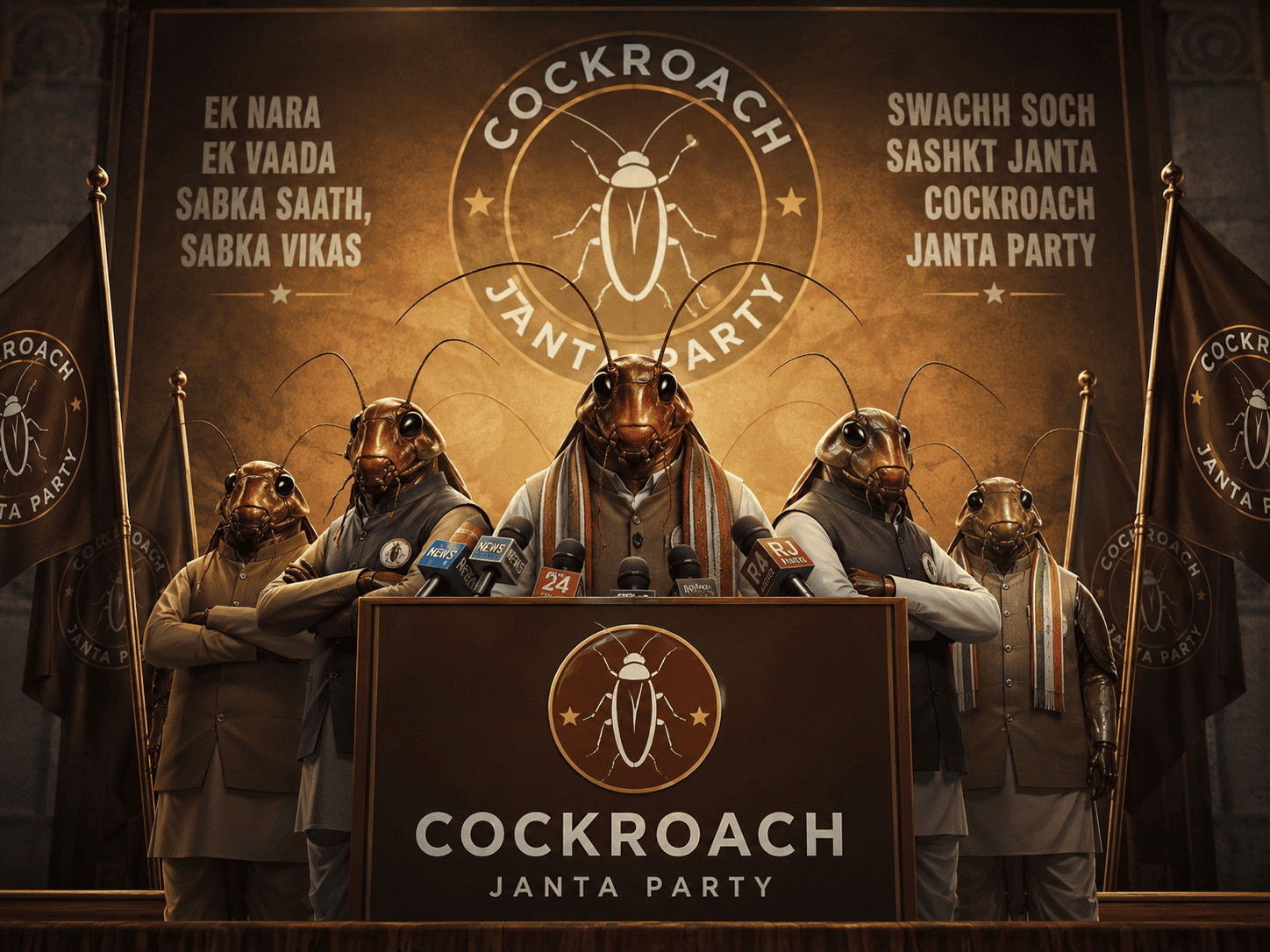
The Cockroach Janta Party has had a fast, unusual trajectory — from an internet joke to a genuine pressure group that forced a cabinet resignation. Born out of a Supreme Court remark in May 2026, the movement grew to more than 20 million Instagram followers within weeks, organized sustained street protests at New Delhi's Jantar Mantar, and weathered a violent police crackdown before securing the resignation of Union Education Minister Dharmendra Pradhan on July 25. Nearly a month later, the group is now in a tense "wait and see" phase over whether promises made to end that protest are actually being honored, with talk of renewed nationwide agitation if they aren't.
|
Instagram Followers (Peak)
20M+
|
July 20 Injuries
~180
|
Days to Resignation
49
|
Outcome
Minister Resigns
|
How It Started
The movement's origin is genuinely satirical. During a Supreme Court hearing on May 15, 2026, Chief Justice of India Surya Kant remarked that there are youngsters who "don't get any employment," some of whom become activists who "start attacking everyone," comparing them to cockroaches. The remark drew immediate public backlash. The following day, political communications strategist Abhijeet Dipke, who had previously worked with the Aam Aadmi Party, announced the launch of a platform for "cockroaches" on X, with eligibility criteria listed as being unemployed, lazy, chronically online, and able to rant professionally — the name itself a deliberate parody of the ruling Bharatiya Janata Party (BJP).
What followed was startlingly fast growth. Within 78 hours of launch, the movement's Instagram account crossed 3 million followers, surpassing 10 million in under five days — overtaking the official accounts of India's two biggest parties. Within days, the group had recorded more than 350,000 sign-ups and topped 20 million Instagram followers, eclipsing both the ruling BJP and the opposition Indian National Congress.
From Meme to Street Movement
What began purely online turned into sustained physical protest fairly quickly, centered at Jantar Mantar in New Delhi, a traditional protest site near Parliament. A series of demonstrations took place there between June 6 and July 25, 2026, initiated by the Cockroach Janta Party alongside left-wing student organizations, with protesters demanding the resignation of Education Minister Dharmendra Pradhan over irregularities in that year's national examinations, including the 2026 NEET paper leak.
The NEET issue carried real human stakes: at least a dozen NEET students died by suicide after the exam troubles, becoming a major focus of the protest and drawing broader support as a result. Social activist Sonam Wangchuk, who had earlier called himself an "honorary cockroach," began a hunger strike at the protest on June 28 demanding Pradhan's resignation. He fasted for 20 days before being forcibly removed by police and continued his fast afterward, with one account putting his eventual total at 26 days.
The July 20 Crackdown: A Turning Point
The most consequential single day of the movement was July 20, 2026, when a large march toward Parliament coincided with the opening of the monsoon session. Coverage from the ground described thousands of protesters marching toward Parliament and facing a police crackdown, in one of the biggest confrontations of the emerging youth-led movement; other outlets reported more than 10,000 protesters braved tear gas and baton charges in what was described as their largest challenge yet to Prime Minister Narendra Modi's government.
Delhi Police's own figures, cited by multiple outlets, put the toll at nearly 180 people injured — 60 protesters and 118 security and police personnel — with 70 protesters detained and legal action initiated against them. Serious allegations emerged regarding the use of pellet guns by security personnel, which Delhi Police denied as "completely false and misleading." A medical report from Safdarjung Hospital, however, confirmed that one protester had suffered wounds from a pellet gun, and a police general diary entry recorded that the Rapid Action Force fired two rounds of pellets that day. A separate, CJP-affiliated source has claimed the injuries were more severe than initially described, alleging that independent forensic experts identified 12-gauge shotgun use — a claim that, notably, comes from a movement-branded website rather than a mainstream outlet directly, and should be treated with appropriate caution pending independent confirmation.
In response to the crackdown, CJP leadership made an unusual choice: rather than escalate with another street march, founder Abhijeet Dipke announced the group would not march through Delhi's streets again, citing safety concerns, while maintaining the sit-in at Jantar Mantar and continuing the broader campaign.
Political Fallout and Opposition Backing
The crackdown pulled national politicians directly into the story. Indian Health Minister J.P. Nadda met with two CJP representatives for about 10 minutes at his residence, marking what appeared to be the government's first real outreach to the movement. On the opposition side, Congress leader Rahul Gandhi marched to Modi's residence the day after the crackdown, saying he was demanding answers over "the brutalities against young students," and calling for both Modi and Home Minister Amit Shah to resign.
Cross-party solidarity had emerged earlier as well: on June 28, an NCP (SP) spokesperson joined the protest and said the Trinamool Congress, DMK, and NCP (SP) had all backed the agitation, and on July 16, former Delhi Chief Minister Arvind Kejriwal joined the protest, calling for Pradhan's removal and even suggesting Wangchuk as a replacement education minister. The government, for its part, dismissed allegations of foreign funding to the movement through its Ministry of External Affairs.
The Resignation and Its Aftermath
The pressure campaign produced a concrete result five days after the crackdown. Education Minister Dharmendra Pradhan resigned on Saturday, July 25 — 49 days after CJP's first, police-permitted march to Jantar Mantar — prompting celebrations at the protest site as the group called off its agitation. Dipke reportedly fell to his knees when the news broke, then raised a fist, before reading aloud the names of students who had died by suicide after the exam cancellations. In his victory speech, he struck a notably cautious tone, warning the crowd against complacency and telling them not to treat the resignation as a reason to let up.
As part of the resolution, the government made concrete commitments: Health Minister Nadda said the FIRs — the criminal complaints filed against demonstrators — would be withdrawn in Delhi and BJP-run states, and that families of students who died after the leak would receive compensation within existing rules, with both sides agreeing to reconvene within four weeks to discuss broader exam reforms. Solidarity actions spread beyond Delhi in the run-up to the resignation, including a demonstration in Mumbai on July 22, while in Assam, six people — most of them Muslim — were arrested for attempting to hold a solidarity protest.
Where It Stands Now: Pressure Group, Not Political Party
After the resignation, CJP made a deliberate strategic choice about its future form. Reporting from early August indicates the group said it would not become a registered political party, opting instead to remain a "pressure group." At a strategy meeting in Maharashtra, group leaders agreed to turn the movement into a nationwide campaign focused on education, jobs, and government accountability.
That meeting was announced in advance: on August 3, CJP said its core team would convene for a two-day strategy session in Chhatrapati Sambhajinagar, Maharashtra, beginning August 5, bringing together the founder, spokespersons, and organizational leadership — including a team of fifty core volunteers who had worked throughout the Jantar Mantar protest — to discuss next steps. Following that session, CJP planned to reach out to volunteers nationwide and organize a "nationwide listening tour" intended to take stock of youth needs and aspirations, building on what the group framed as the Jantar Mantar success.
Is a New Protest Brewing?
This is where the picture turns from settled to genuinely uncertain — one of rising tension rather than an announced march. CJP has said it would launch a fresh nationwide agitation if the government did not fulfil its assurance of withdrawing FIRs against demonstrators, tying the threat of renewed protest explicitly to whether Delhi and BJP-run state governments follow through on that commitment.
The most current signal, from a CJP-affiliated source updated within the past few days, suggests that commitment is now in doubt: student leaders associated with the movement have reportedly issued what they describe as a "final ultimatum" to the administration, alleging that key commitments — including action on FIR withdrawals and accountability measures — have not been met. The same source references some internal turbulence as well, including the removal of a spokesperson following controversy over videos, and fresh allegations of tear gas and baton use against protesters at a more recent, smaller march. It's worth flagging clearly that these more granular claims come from CJP-branded or CJP-adjacent sources rather than wire services or major outlets independently verifying them, so the specifics should be treated as reported by sympathetic sources pending broader confirmation — even though the general trajectory, a "final ultimatum" over unmet FIR-withdrawal promises, is consistent with the explicit conditional-agitation warning reported elsewhere.
What to Watch
In a real sense, the movement is "again planning some protest," but as of the most recent reporting it remains conditional and threatened rather than scheduled. CJP has explicitly said it will launch a fresh nationwide agitation if the government doesn't follow through on withdrawing FIRs against protesters and on the accountability measures promised when Education Minister Pradhan resigned, and the group's most recent messaging frames this as a "final ultimatum" — suggesting its leadership believes the government is currently falling short of those commitments.
At the same time, the group has structurally repositioned itself since July: deliberately choosing to remain an unregistered pressure group rather than forming a political party, and pivoting toward a nationwide "listening tour" model to build grassroots organization rather than immediately staging another mass Delhi march, partly out of stated safety concerns following the violent July 20 crackdown. Whether the "final ultimatum" turns into another Jantar Mantar-style mobilization will likely depend on whether the Modi government moves visibly on the FIR withdrawals in the coming weeks — the specific trigger CJP itself has named for renewed nationwide agitation.
NPR; Al Jazeera; Bloomberg; Deccan Herald; The Christian Post; Time; Britannica; Wikipedia; Delhi Police public statements; CJP-affiliated communications.
Some details in the later sections of this report, including allegations of internal turbulence within the movement and specific claims about weapons used on July 20, originate from CJP-affiliated sources and have not been independently verified by wire services or major outlets. These points are noted accordingly and should be treated with appropriate caution.
TopNews Hindi
- FSSAI की शराब कार्रवाई: मैकडॉवेल्स नंबर 1, Old Monk, Antiquity Blue, Royal Challenge पर बैन
- Karuppu, Parasakthi, Thaai Kizhavi, Blast and Kara Among Best Tamil Movies for 2026
- Anupama, YRKKH, Vasudha, Tum Se Tum Tak: सबसे ज़्यादा देखे जाने वाले धारावाहिक
- 2026 FIFA World Cup Current Rankings and Betting Odds for Sports Betting Fans
- JEE Main 2026: Exam Dates, Eligibility, Syllabus जेईई मेन 2026 परीक्षा की तारीखें, योग्यता, सिलेबस

