World's biggest race is just a fun run
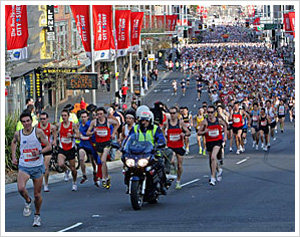 Sydney - Sydney's City2Surf, the world's largest timed running event, is an annual marker of how immigration, feminism and flab-fighting is changing Australia's biggest city.
"In the early days there were no women, and a time in the upper 50s could get you in the first 2,000," said Jim Webster, who has competed in the 14-kilometre race every year since it started in 1971.
Last weekend, when half the 75,000 runners were women, a sub-60-minute time over the hilly course from the centre of the city to Bondi Beach could still get you in the first few thousand names.
The City2Surf has morphed from serious race to fun run with a bigger field than the Boston and London Marathons combined. Standards have plummeted, with the average time probably doubling.
The men's record of 40 minutes and 3 seconds, set way back in 1991 by Melbourne's Steve Moneghetti, still looks safe.
"People say, 'How come your race record has lasted for so long?' and I say, "Well, we haven't had the depth in Australian running that we have now,'" Moneghetti said.
This year's winner, Michael Shelley, was 1 minute outside Moneghetti's time. The first woman home, Melinda Vernon in 47:46, slashed 1:43 off her best time for the distance but missed out on a record all the same.
Some argue that the golden age of running was the 1970s, when Jim Fixx inspired a generation of joggers to strive for better times. Then, it was Europeans who were setting the tracks alight rather than Africans.
The stickiness of Moneghetti's record is proof that wider participation doesn't translate into better performance. Consider this: Keith Bateman, a Sydney club runner in his 50s, again managed to finish in the top 50 in this year's City2Surf.
Over the past 13 years, Australians have only won their most famous running race twice. And, oddly enough, no one from Sydney has ever been the victor in the city's biggest sporting event.
Some say the mediocre times from such a massive field reflects the difficulty of the course. It's too long for the standard weekend 10-kilometre warrior and too hilly to attract speedsters. The purse is not big enough to entice a truly world-class international field.
In the early 1970s, when Colin Walden ran the first of his 36 City2Surfs, the race was the preserve of proper runners. There weren't people dressed as gorillas, jilted brides, Spidermen, bananas, fighter pilots, surgeons, mushrooms and Smurfs.
Competitors didn't stop for a coffee and a round of raisin toast.
Walden now leaves the real running to his children, who first did the distance on dad's shoulders. "I missed the first three but since then I've done it all ways," Walden said. "I've pushed a stroller, I've enjoyed it as a family, and now my children run as well - and they're ahead of me."
Recent years have seen newborns entered, replete with their own numbers. Parents, it seems, are competing to see how many City2Surfs their children can possibly complete.
At the other end of the spectrum is a 98-year-old, evidence that fitness these days is no longer the domain of the young but a lifelong preoccupation.
There is no longer anything remarkable about the not-so-young and the not-so-slim dragging on the lycra and sweating alongside the gym-toned and wrinkle-free. While sports on television is all about those barely out of school, exercise in the harbour city has become ageless.
Thirty years ago, the standard City2Surf runner was white, well-off and had a wife and children waiting at home. Now, the field is a snapshot of a changed society.
"We're Muslims, Christians, Jews, indigenous people and others who enjoy being together," said Rabbi Zalman Kastel, leader of a group running under the Together for Humanity banner.
Also in matching running strip were members of the Jesus All About Life team, who smiled sweetly when they were harangued by a spectator seeking conversions on the road to Bondi.
He shook a Bible while exhorting them to "run the real race" rather than have fun with the fake runners in fancy dress. (dpa)
TopNews Hindi
- आज का मौसम 29 मई: 16 राज्यों में तूफानी बारिश का अलर्ट, दिल्ली में राहत की उम्मीद लेकिन मानसून अभी दूर
- सोने और चांदी की कीमतों में मामूली गिरावट (Gold Price Declines Today), 22Karat सोना 1,56,600 रुपये प्रति 10 ग्राम
- वैभव सूर्यवंशी (Vaibhav Sooryavanshi) की IPL 2026 में राजस्थान रॉयल्स में रिकॉर्ड तोड़ बल्लेबाज़ी
- कल का मौसम: दिल्ली, हरियाणा, राजस्थान, पंजाब और उत्तर प्रदेश में अत्यधिक गर्म मौसम
- आज का मौसम: दिल्ली में भीषण गर्मी का प्रकोप, 45°C के पार पहुंचा पारा

