Delta Exchange India Leads Cryptocurrency Trading in India with Wide Range of Altcoins for Trade
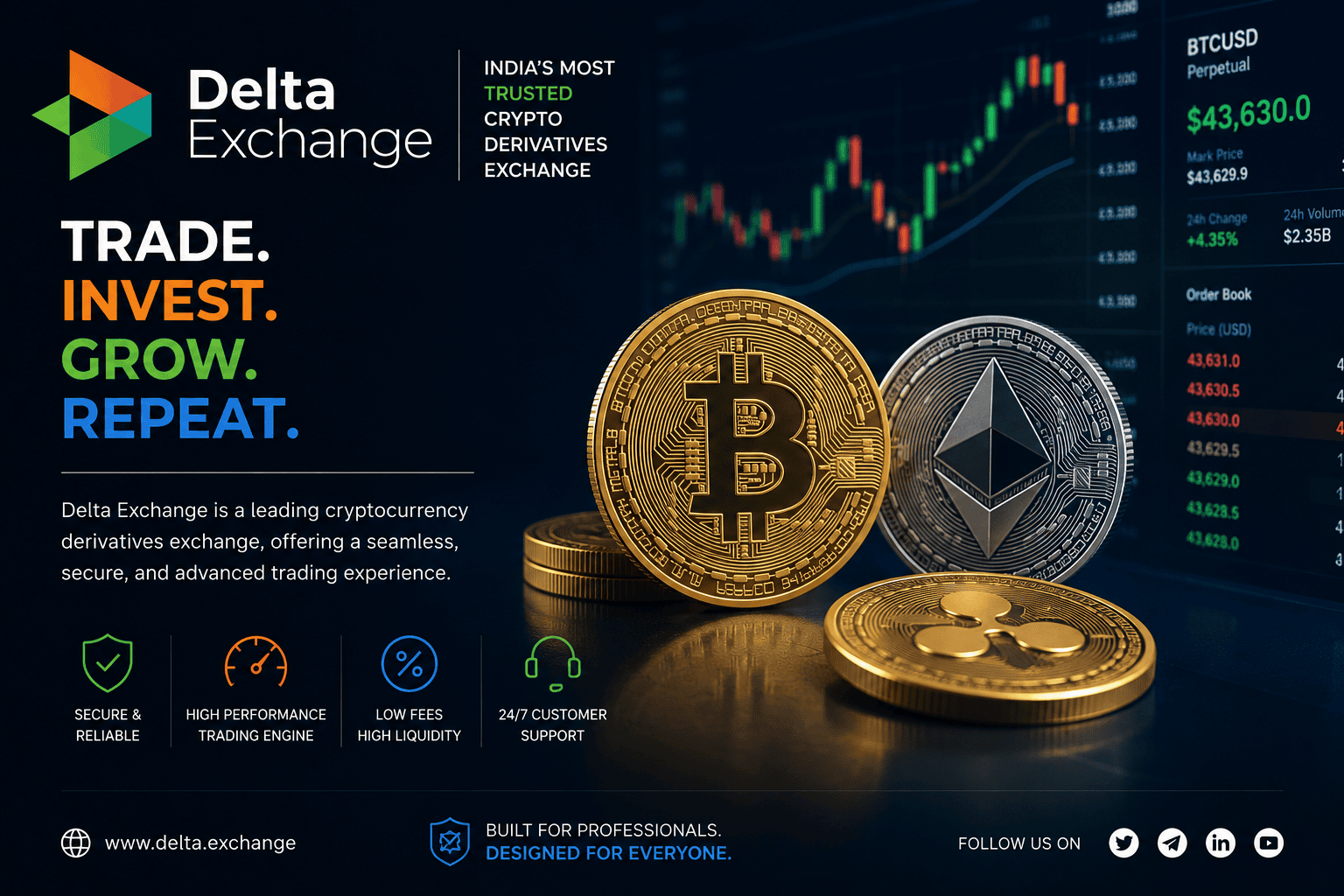
India’s cryptocurrency ecosystem has evolved from a speculative niche into one of the world’s most dynamic digital asset markets, driven by rising retail participation, clearer regulation, and rapid technological adoption. Despite a stringent taxation regime and heightened compliance requirements, Indian traders continue to embrace crypto at scale, with derivatives trading emerging as a major growth engine. As competition intensifies among domestic and international exchanges, platforms are increasingly differentiated not merely by token listings, but by regulatory credibility, liquidity depth, trading sophistication, and ease of INR integration. Among these platforms, Delta Exchange has established itself as a leading derivatives-focused ecosystem tailored specifically for Indian traders seeking institutional-grade infrastructure within a locally compliant framework.
The Evolution of India’s Cryptocurrency Market
India’s journey toward becoming a global cryptocurrency powerhouse has been both dramatic and unconventional. What began as a speculative playground for technology enthusiasts has transformed into a sophisticated financial ecosystem involving millions of active participants, institutional infrastructure, and increasingly mature trading behavior.
India emerged as the world’s largest crypto adoption market by 2026, maintaining the top position in Chainalysis rankings for three consecutive years. The country reportedly accounted for approximately 119 million active crypto users and generated nearly $338 billion in annual on-chain transaction volume during the period ending June 2025.
Several structural forces have contributed to this expansion. Widespread smartphone penetration, cheaper internet access, rising digital literacy, and increasing familiarity with fintech products have collectively accelerated crypto participation across India’s urban and semi-urban population centers.
More importantly, the market has matured alongside regulation rather than in opposition to it.
India now classifies cryptocurrencies as Virtual Digital Assets (VDAs) rather than legal tender, bringing the sector under a clearer compliance framework. Exchanges serving Indian users are required to register with the Financial Intelligence Unit of India (FIU-IND), while traders face a 30% tax on profits and 1% TDS on transactions.
Although critics argued that these tax rules would suppress participation, the opposite appears to have occurred. Trading volumes and retail participation have continued climbing, suggesting that crypto has become deeply embedded within India’s broader retail investing culture.
Regulatory Oversight Is Reshaping Platform Credibility
The Indian government’s tightening oversight has significantly altered how crypto exchanges operate. Compliance has evolved from an optional feature into a core competitive advantage.
In FY 2024–25, 49 crypto exchanges secured FIU-IND registration, including both domestic and overseas operators serving Indian customers. Exchanges are now obligated to comply with strict anti-money laundering protocols, perform customer verification procedures, and collect PAN details for all VDA-related activity.
This shift has fundamentally changed investor psychology.
For retail participants, FIU registration increasingly serves as a primary credibility benchmark. In a sector historically associated with offshore opacity and regulatory uncertainty, exchanges demonstrating local compliance now enjoy a significant trust premium.
The tightening framework has also forced weaker operators out of the market while encouraging more established platforms to strengthen security infrastructure, banking relationships, and operational transparency.
As a result, the Indian crypto market in 2026 looks considerably more institutionalized than it did just a few years ago.
The Competitive Landscape of Indian Crypto Exchanges
India’s exchange ecosystem today represents a blend of domestic champions, niche innovators, and international heavyweights competing for different trader segments.
CoinDCX and WazirX continue to dominate mainstream retail spot trading, offering user-friendly interfaces and broad token access. Both platforms endured major operational crises in 2025 but ultimately demonstrated resilience under pressure.
CoinDCX reportedly preserved customer assets in segregated cold wallets during a July 2025 incident and absorbed approximately $44 million in losses through internal reserves. Meanwhile, WazirX spent over a year rebuilding trust following a $230 million hack, eventually relaunching with BitGo custody support and a temporary zero-fee trading campaign.
CoinSwitch has increasingly positioned itself as a gateway platform for first-time derivatives traders, emphasizing simplicity and accessibility rather than professional-grade complexity.
Another emerging player, Pi42, has attempted to carve out a unique regulatory angle by offering INR-based perpetual products that it argues may fall outside India’s VDA tax framework. However, this interpretation remains legally untested and introduces uncertainty for traders seeking long-term compliance clarity.
Global giants such as Binance, Coinbase, Kraken, and Bitget continue attracting Indian users through deep liquidity and broader asset availability. However, these platforms typically require USDT conversions, cross-border transfers, and more complex tax reporting structures — factors that increasingly matter in India’s regulated environment.
Against this backdrop, Delta Exchange has emerged as one of the most strategically differentiated platforms in the country.
Delta Exchange and the Rise of India’s Derivatives Economy
Founded in 2018 by Pankaj Balani, Jitender Tokas, and Saurabh Goyal, Delta Exchange was designed with a specific objective: create a professional-grade crypto derivatives ecosystem tailored to the evolving sophistication of Indian traders.
While many exchanges initially prioritized speculative retail spot trading, Delta focused on derivatives infrastructure — an area that has become increasingly important as traders adopt hedging, leverage, options strategies, and advanced risk management techniques.
By May 2025, CEO Pankaj Balani stated that the platform was processing approximately $2.5 billion in daily trading volume, with peak volumes touching nearly $4 billion in a single day.
These figures place Delta firmly among the most significant derivatives platforms serving the Indian market.
INR-Native Trading Solves a Major Pain Point
One of Delta Exchange’s most important competitive advantages lies in its INR-first architecture.
Most international crypto derivatives platforms require traders to first purchase USDT or another stablecoin before accessing futures or options markets. This introduces several layers of friction, including conversion costs, stablecoin exposure, tax complications, and operational inefficiency.
Delta removes much of that complexity.
Users can deposit, trade, and withdraw directly in Indian Rupees without holding cryptocurrency outright.
For Indian traders operating under strict VDA taxation rules, this creates a significantly cleaner workflow. INR-denominated accounting simplifies tax reporting while minimizing foreign exchange exposure and stablecoin volatility risk.
This structure is particularly attractive for retail derivatives traders who want exposure to crypto price movements without navigating complex wallet infrastructure or offshore banking processes.
Compliance as a Strategic Advantage
Regulatory legitimacy has become one of the most decisive factors in India’s crypto market, and Delta Exchange has positioned itself aggressively around compliance.
The platform operates under Excelium Technologies Private Limited and maintains full FIU-IND registration under the Prevention of Money Laundering Act.
Its operational framework includes:
- Mandatory KYC verification
- 1% TDS deduction compliance
- AML transaction monitoring
- PAN-linked user verification
- Suspicious activity reporting obligations
In practical terms, this provides traders with an important layer of legal and operational certainty.
At a time when many offshore exchanges continue operating in regulatory grey zones, Delta’s transparent compliance posture strengthens both institutional confidence and retail trust.
A Sophisticated Derivatives Product Suite
Delta Exchange distinguishes itself further through the breadth and sophistication of its derivatives offering.
The platform supports futures, perpetual contracts, and European-style options across major cryptocurrencies including Bitcoin, Ethereum, Solana, Ripple, and Litecoin, alongside more than 50 alternative digital assets.
Importantly, traders can access multiple expiry structures, including:
- Daily contracts
- Weekly contracts
- Bi-weekly contracts
- Monthly contracts
This flexibility enables traders to implement a broad range of strategies, from short-term volatility plays to longer-term directional positioning and hedging structures.
The fee architecture also remains highly competitive.
| Trading Product | Maker Fee | Taker Fee |
|---|---|---|
| Crypto Futures | 0.02% | 0.05% |
| Vanilla Options | 0.010% | 0.03% |
| Spot Sell | 0.10% | 0.10% |
All fees attract 18% GST.
For active traders and high-frequency participants, these economics can materially improve long-term profitability compared with higher-cost competitors.
Lowering the Entry Barrier for Retail Traders
Historically, derivatives markets have been dominated by well-capitalized professional traders. Delta Exchange has deliberately attempted to democratize access.
Bitcoin contract sizes begin at roughly Rs 5,000, while Ethereum contracts start near Rs 2,500.
The platform also allows users to begin trading with very small capital allocations, lowering psychological and financial barriers for newcomers interested in learning derivatives strategies gradually.
This accessibility matters because India’s crypto growth is increasingly retail-driven. Platforms that enable progressive learning rather than forcing aggressive leverage adoption are likely to build stronger long-term user retention.
Professional Infrastructure for Advanced Traders
Delta Exchange’s appeal extends beyond beginners.
The platform offers a range of advanced trading tools typically associated with institutional-grade infrastructure, including:
- Stop-loss and take-profit automation
- Multi-leg options strategies
- Visual payoff analysis charts
- API integrations for algorithmic trading
- Demo accounts for strategy testing
The inclusion of demo trading functionality is particularly notable.
For inexperienced traders, it creates a low-risk educational environment. For experienced participants, it provides a framework for backtesting sophisticated strategies before deploying live capital.
This dual appeal strengthens Delta’s positioning across multiple trader categories simultaneously.
Security and Infrastructure Remain Critical Priorities
Security remains one of the defining issues within global crypto markets, especially following a series of major exchange breaches over recent years.
Delta Exchange has responded with a layered security model that includes:
- Industry-grade encryption
- Multi-signature wallet infrastructure
- Two-factor authentication
- Automatic inactivity logout protection
- Restricted INR withdrawals to registered bank accounts
The platform’s onboarding process also emphasizes simplicity without compromising compliance. Users reportedly require only PAN and Aadhaar verification, with KYC completion often taking under a minute.
In a market where operational trust increasingly determines platform survival, these details carry significant weight.
The Strategic Future of India’s Crypto Derivatives Market
India’s crypto market is no longer defined by speculative enthusiasm alone. It is increasingly characterized by structured participation, compliance-oriented growth, and rising demand for sophisticated financial instruments.
The country’s contribution to global crypto derivatives trading reportedly climbed from 4% in 2022 to 7% in 2024, while INR-focused derivatives platforms recorded approximately 40% year-over-year user growth.
Delta Exchange sits directly at the center of this transition.
The platform has successfully positioned itself between two extremes:
- Highly complex global exchanges requiring offshore workflows
- Simplified domestic spot exchanges lacking advanced derivatives depth
That middle ground may ultimately prove to be the most strategically valuable segment of India’s crypto ecosystem.
Final Thoughts
India’s digital asset economy has matured into one of the world’s most consequential crypto markets, supported by regulation, scale, and increasingly sophisticated trader behavior. The next phase of growth is unlikely to be driven merely by token speculation. Instead, it will revolve around infrastructure quality, regulatory credibility, derivatives sophistication, and user trust.
Delta Exchange appears well-positioned to benefit from precisely those trends.
Its combination of INR-native trading, FIU registration, advanced derivatives functionality, institutional-grade tools, and accessible retail onboarding creates a compelling proposition for Indian traders navigating an increasingly regulated environment.
For market participants seeking professional crypto derivatives exposure without the operational complications of offshore platforms, Delta Exchange has established itself as one of the most complete ecosystems currently available in India’s rapidly evolving digital asset landscape.
Disclaimer: Cryptocurrency trading involves substantial risk and may not be appropriate for all investors. This article is intended solely for informational purposes and should not be interpreted as investment or financial advice. Investors should consult qualified financial professionals before making investment decisions.
TopNews Hindi
- Karuppu, Parasakthi, Thaai Kizhavi, Blast and Kara Among Best Tamil Movies for 2026
- Anupama, YRKKH, Vasudha, Tum Se Tum Tak: सबसे ज़्यादा देखे जाने वाले धारावाहिक
- 2026 FIFA World Cup Current Rankings and Betting Odds for Sports Betting Fans
- JEE Main 2026: Exam Dates, Eligibility, Syllabus जेईई मेन 2026 परीक्षा की तारीखें, योग्यता, सिलेबस
- Geojit ने Apollo Hospitals पर BUY कॉल दोहराया, Share Price Target Rs. 9,587

